

The South Coast Cabinet of Curiosities
Relics of Time. Creatures of Legend. Wonders from the Edge of the Ring!

Step inside the strange side of South Coast Circus! The only permanent public Cabinet of Curiosities in South Australia!
Hidden beside the training floor is a growing collection of fossils, oddities, cryptid casts, ocean relics and circus curiosities.
A cabinet built to spark wonder, questions and stories.
A world with no mystery is small and uninspiring. A world with unanswered questions is still alive!

Sasquatch and Orang Pendek casts on display at South Coast Circus
Before the big tops, before the stages, before the fire... There was the sideshow... The cabinet...
The Cabinet of Curiosities is an old tradition, born of circuses, sailors, collectors and dreamers who believed the world was far too strange to ever be fully mapped.
The South Coast Cabinet of Curiosities carries that tradition forward.
Within these shelves live fragments of legend. This is not a museum of answers. It is a shrine to wonder!
Let's take a peek!

The Kingdom of the Sea

Before the ring was raised, before the land was settled... the world belonged to the ocean.
Here lie its remnants.
Teeth from ancient hunters. Shells shaped by time and pressure. Creatures that drifted through warm, shallow seas long before this coastline took its modern shape.
Some are millions of years old. Some echo the same forms that have survived hundreds of millions of years.

Preserved Marine Specimens including crabs, seahorses, an octopus and an ornate cowfish

Smooth Hammerhead shark jaw

Preserved Marine Specimens - jellyfish and a cuttlefish
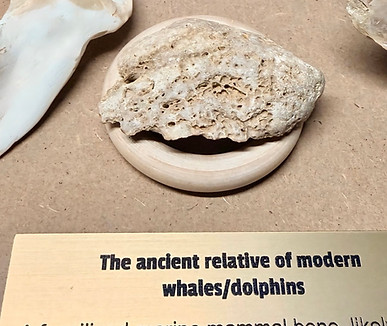
Fossilised Marine Mammal bone found at Pt Willunga Beach, likely from the extinct relative of modern whales/dolphins

Fossilised Oyster Geode discovered at Pt Willunga Beach, crystallised over millions of years
The Realm Before Time

Knightia Fish ~ 52 Million years old
Long before anything we now recognise had a name... there were GIANTS!
A river predator tearing through ancient waters - Spinosaurus ~ 112 million years old.
Long-necked hunters gliding through inland seas, perhaps still in ancient lochs - Plesiosaur ~ 100 million years old.
Armoured grazers and three horned titans - Triceratops ~ 68 million years old.
Finally the apex of them all - Tyrannosaurus Rex ~ 68 million years old.
Even after their fall, life endured.
Fish like Knightia ~ 52 million years old filled ancient lakes. Sea monsters like the mighty Megalodon ~16 million years old, ruled the oceans, including where you now stand!
And... far earlier still, the precursor to the legendary long-necked marine giants - Keichousaurus ~ 230 million years old.
These are not replicas of imagination. The are pieces of reality. Fragments of creatures that lived, hunted, fed and died on the very ground that would one day become ours.

Orthoceras - 400 MYO

Plesiosaur tooth - 100.5-66 MYO

Tyrannosaurus Rex bone fragment 69-66 MYO

Keichousaurus skull with teeth in tact

Spinosaurus tooth - 112-93.5 MYO

Megalodon tooth 16-13.8 MYO - 5.15" long (large specimen - likely a 40 foot shark)
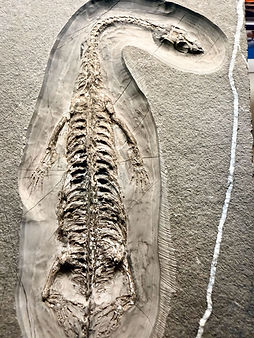
Keichousaurus (kye-cho-sore-us) - 230 MYO

Triceratops tooth - 68-66 MYO

Mosasaur tooth in matrix 100-66 MYO
The Age of Fire and Stone

After the age of giants... We arrived. Not to rule but to survive!
This was a world of firelight and sharpened stone. A time when early humans walked the land alongside the last of the great beasts, shaping tools by hand and learning how to endure.
The arrowheads you see here were not crafted in comfort. They were made for a world where every movement mattered. Where skill meant survival.
Beside them, hairs of the Mammoth and a guitar pick carved from its mighty tusk! A reminder that these were not distant creatures of imagination, but part of the same world we lived in.
Not everything that feels ancient is gone however...
The Draco - a gliding lizard often called the dragon lizard, still lives today, carrying the silhouette of something far older. A creature that blurs the line between past and present, reality and legend.
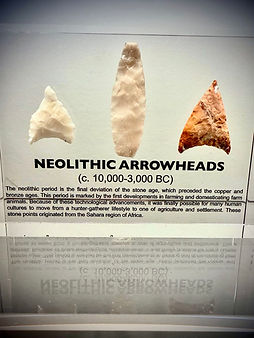
Neolithic Arrowheads - Africa

Mammoth Ivory Guitar Pick

Wooly Mammoth hair - Siberia

Sourced from the Boneyard Alaska

Draco Volans - Flying Lizard specimen

Dating between 10,000 to 40,000 years old
Mysteries of Australia and the South Pacific

Scientifically accurate replica of a thylacine skull. The Haunt of the Marsupial Wolf documents ongoing evidence of the survival of the thylacine on mainland Australia.
This is the land that remembers...
Long before cities and coastlines were mapped giants walked here. Diprotodon, the largest marsupial to ever live, moved across this country in an age not so far removed from our own.
Some things may not be gone at all...
The thylacine, officially lost but never truly laid to rest. It lingers on with countless sightings across Australia, Tasmania and Papua New Guinea and through stories, legend and fragments of evidence. A skull, a track, a postcard, a record in print. Each a piece of a puzzle that refuses to close.
Even the familiar carries deeper meaning. The emu stands as a link to a much older world. A reminder that the line between ancient and present is thinner than it seems.
Then there's the Vanuatu Nautilus. A creature that has survived til this day unchanged for over 500 million years!
Not everything that disappears is gone...

A South Australian postcard from 1907 featuring the "Australian Wolf" or thylacine...

Diprotodon bone fragment

Yowie - Australia's Bigfoot

Emu egg

Vanuatu Nautilus

Relics of Australia and the South Pacific
The Nannup Tiger
Legends do not always live in museums. Sometimes they live in forests, in whispered stories, and in places where people still insist they have seen something that should no longer exist.
On a journey through Western Australia, Scott and Zakk visited the town of Nannup; home to one of Australia’s most enduring mysteries: reports of the Nannup Tiger.
For decades, locals have described encounters with an animal matching the appearance of the long-lost Thylacine: a creature around the size of a Labrador, with a large head, upright ears, a stiff tail and distinctive dark stripes.
Across the town, the mystery has become part of local identity. Sculptures stand in celebration of the stories, signs tell of sightings in the surrounding forests, and the legend remains alive among the community.
At the South Coast Cabinet of Curiosities, we are fascinated by the place where folklore, eyewitness accounts, history and possibility overlap, because many legends begin with somebody seeing something they couldn’t explain.
Curator’s Note:
“Our Australian & South Pacific section already houses a Thylacine replica and regional cryptid material. Visiting Nannup felt less like visiting a tourist attraction and more like stepping into a place where the legend is still breathing.”

Sign in Nannup, Western Australia, describing ongoing Thylacine sightings

The Nannup Thylacine sculpture


Nannup Tiger information sign

The Nannup Thylacine sculpture plaque

Stripes in the Forest Thylacine Trail statue

Zakk and the Nannup Thylacine sculpture - 2025
South Australian thylacine trackway
The Thylacine Awareness Group of Australia (TAGOA) is an organisation dedicated to investigating reports of possible surviving thylacines throughout Australia.
By collecting eyewitness accounts, analysing photographs, videos, audio recordings and track evidence as well as conducting field investigations TAGOA seeks to document and preserve information relating to one of Australia's greatest wildlife mysteries.
In fact Scott has previously helped TAGOA process alleged thylacine audio using his skills as a sound engineer.
TAGOA's work has brought together thousands of observations and fascinating pieces of evidence from across the country and continues to contribute to the search for the elusive thylacine.
Neil Waters (President of TAGOA) personally donated the below replica cast, from a South Australian trackway discovered by researchers Neil Waters and John Maguire in 2016, to South Coast Circus. The cast is one of a series of unusually large five-toed tracks that clearly display features consistent with historical thylacine footprints.
For an ongoing record of documented thylacine sightings and to read more about this discovery we recommend you visit;
www.thylacineawarenessgroupofaustralia.com.au

Alleged thylacine cast reproduction from a 2016 South Australian trackway donated by Neil Waters (TAGOA)
The cast is substantially larger than documented thylacine tracks, however, the sample size is small, the morphology is congruent with thylacine prints and no better locally occurring source has been identified.
The three eared quokka
Found on Rottnest Island during our travels to the Lunar Circus Festival, this curious little creature stopped us in our tracks.
At first glance it appeared to be an ordinary quokka, one of Western Australia’s most beloved animals. But as we watched, something unusual became apparent…
It had three ears.
Not a trick of the light. Not a leaf caught in its fur. An additional ear-like structure sat on the centre of its head moving as the animal explored the island.
Perhaps a rare quirk of nature. Perhaps a developmental anomaly. Whatever the explanation, it was a reminder that the natural world still holds its own curiosities and wonders.
In the old travelling sideshows, such creatures would have been displayed as marvels of nature. Today, we simply appreciate them for what they are… proof that nature rarely follows all of the rules we expect it to.
A small island.
A small animal.
A very unusual encounter.
Somewhere on Rottnest, the Three-Eared Quokka still wanders.

This picture clearly shows the 3 independent ears on this quokka

3 eared quokka we discovered in January, 2025
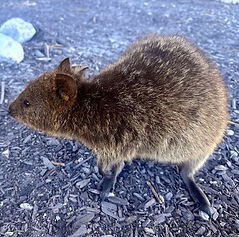
3 eared quokka, Rottnest Island, 2025
relics of a lost australia
On our travels, we sometimes stumble upon reminders that Australia was once a very different place.
Deep beneath the earth in a Margaret River cave rests the skeleton of a giant short-faced kangaroo, preserved where it fell thousands of years ago.
A silent witness from an age when marsupials grew to enormous sizes and the continent belonged to giants.
Further east, in the ancient cave systems of Naracoorte, waits another legend of the Dreaming Lands...
Thylacoleo Carnifex… The Marsupial Lion.
Not a lion at all, but Australia's most formidable mammalian predator. Armed with powerful jaws and blade-like teeth, it ruled an Australia now lost to time.
Standing before these creatures, it is impossible not to feel the weight of deep time.
Before the cities.
Before the roads.
Before the circus.
There was another Australia.
An Australia of giant kangaroos, thunderous wombats, towering reptiles and predators unlike anything alive today.
Their bones remain hidden beneath the earth, waiting for curious souls to find them.

Reconstructed Thylacoleo Carnifex - Naracoorte, South Australia

Zakk with the Naracoorte Diprotodon statue

Fossilised Giant Short-faced Kangaroo - Margaret River, Western Australia
The Australian Age of Dinosaurs

Long before Australia was home to giant marsupials, the continent belonged to dinosaurs.
This display centres on a replica footprint cast from the famous Dinosaur Stampede at Lark Quarry in Queensland, one of the world’s most remarkable dinosaur track sites. The track belongs to a small carnivorous dinosaur known as Skartopus Australis, the “southern nimble foot”, a swift hunter that once raced across muddy floodplains more than 90 million years ago. Think turkey sized raptor.
Accompanying the footprint are samples of genuine site material collected near Winton, Queensland. Sometimes called “dinosaur dust,” this sieved sediment contains tiny dinosaur fossil fragments, ancient plant remains, gypsum, and remnants of the plaster jackets used by palaeontologists during excavations.
Together, these pieces offer a tangible link to Australia’s Age of Dinosaurs, preserving traces of animals whose footsteps once crossed a prehistoric landscape long vanished beneath the Australian outback.

Skartopus Australis track cast - Dinosaur Stampede, Lark Quarry, Queensland
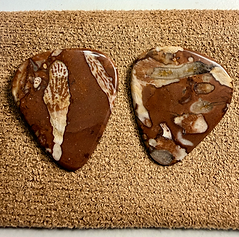
Archaeocyatha picks - 530 MYO, Andamooka, South Australia

Archaeocyatha picks - 530 MYO, Andamooka, South Australia
The Hall of Echoes
The SRST exotic guitar pick collection

Forged in the birth of the solar Solar System, Built by the first reefs of the Cambrian Oceans, Carried through the Age of Dinosaurs, Surviving the Ice Age and now reborn as instruments of music in the hands of our own Scott Reed's String Theory.
Most guitar picks are made to be used. These are made to tell stories.
The Pick Collection brings together rare materials that span the history of our planet and our species, transforming fragments of deep time into playable works of art. Each pick carries a story far older than any song; from mammoths that walked the Ice Age tundra, to meteorites forged in the birth of the Solar System itself.
Among the collection are picks crafted from genuine Mammoth Ivory, preserved in the frozen ground of Alaska for tens of thousands of years before being given a new voice through music. Alongside them are picks cut from Muonionalusta meteorite, a celestial visitor that formed over 4.5 billion years ago before falling to Earth long before human history began.
These extraordinary materials bridge worlds that rarely meet: science and art, prehistory and performance, the ancient past and the present moment.
Muonionalusta Meteorite Pick
Forged in the birth of the Solar System over 4.5 billion years ago, this guitar pick was cut from the Muonionalusta meteorite, one of the oldest materials a person can hold. Older than the Earth itself, it journeyed through space before falling to our planet and finding a new voice through music.
Archaeocyatha Fossil Picks
Carved from fossilised Archaeocyatha, these picks originate from one of Earth’s earliest reef-building animals. Collected from South Australia’s ancient seabeds and dating back approximately 538 million years, they come from a world long before dinosaurs, forests, or even life on land. Preserved through deep time and often crystallised by mineral-rich waters, each piece carries the story of one of the first complex marine ecosystems on our planet.
Dinosaur Bone Pick
Created from genuine fossilised dinosaur bone, this pick allows axemen to hold a piece of the Mesozoic Era in their hands. Once part of a living dinosaur, it has survived millions of years to become both a curiosity and a tool of creativity.
Mammoth Ivory Pick
Crafted from genuine woolly mammoth ivory preserved in the frozen ground of Alaska, this pick transforms a relic of the Ice Age into a musical instrument. After tens of thousands of years frozen in silence, the mammoth roars once more.
Stones, Shells and Earthly Wonders
Not every story in the Hall of Echoes comes from deep prehistory. This collection celebrates the remarkable materials of the natural world, transformed into instruments of music and art.
From shimmering black abalone shell formed beneath the waves, to modern Buffalo horn, to volcanic obsidian born in fire, to gemstones such as labradorite, malachite, tiger’s eye, amethyst and turquoise, each pick showcases a different chapter in Earth’s geological story. Some were forged by ancient volcanoes, others crystallised deep within the planet, while some were shaped by oceans over countless generations.
Together they demonstrate that wonder is not only found in extinct giants and fallen stars. Sometimes it can be found in the stones beneath our feet, the shells along a shoreline, and the hidden beauty of the natural world around us.

Muonionalusta Meteorite - 4.5 BYO

Dinosaur bone

Abalone

Mahogany Obsidian Volcanic Glass

Crocodile Jasper

Green Malachite

Archaeocyatha pick 1 - 530 MYO, Andamooka, South Australia

Mammoth tusk - 40 KYO - Alaska

Palm wood

Amethyst

Red Tiger's Eye

Turquoise

Archaeocyatha pick 2 - 530 MYO, Andamooka, South Australia

Buffalo horn

Obsidian Volcanic Glass

Labradorite

Yellow Tiger's Eye

The Hall of Echoes

Scott playing guitar using the Alaskan Woolly Mammoth Tusk
The Unresolved

Bigfoot, Sasquatch, Yowie, Yeti. They appear and leave tracks all over the world yet remain the planets most fascinating and enduring mystery. Here's the best evidence we have found.
Bigfoot!!!
Not everything fits neatly into history.
Across continents and generations, stories persist of something moving just beyond certainty. Not myth alone… but something leaving traces behind.
Footprints. Casts. Impressions in the ground that show weight, movement, and structure. Not imagined but recorded.
The prints displayed here, including the Patterson-Gimlin track, the Titmus cast, and the work of researchers like Dr. Jeff Meldrum present a question that has not been fully answered. The mid-tarsal flexibility seen in some casts suggests a form of locomotion unlike modern humans, yet not entirely unlike our distant ancestors.
From North America to Southeast Asia, similar accounts emerge. The Orang Pendek - smaller, elusive, but sharing traits that echo across regions.
Alongside these are books, field research, and documented investigations. Attempts to understand.
This section does not ask you to believe.
It asks you to look.
Because the question is not just “is it real?”
but rather
why does the evidence keep appearing?
The Patterson-Gimlin Footprint 1967
In 1967, long before camera phones and AI, filmmakers Roger Patterson and Bob Gimlin recorded what remains the most debated piece of footage in cryptozoological history. The film depicts a large, unknown, bipedal figure moving through remote forestland in Northern California. Footprints were discovered at the site shortly after the encounter. Our replica is taken from casts made of those original tracks. To this day the film remains hotly disputed, praised by some as evidence of bigfoot.
Bill Munns, a Hollywood special effects and creature suit artist, argues that this film does not depict a man in a costume. He argues that the anatomical details, body proportions, movement and bodily features would have been extremely difficult to produce with the 1967 technology, leading him to conclude that the film likely depicts a real creature.

"Patty" bigfoot subject frame 352 from the original film

Original "Patty" Bigfoot subject and a face enhancement by Rob Roy Menzies

Bob Gimlin holding the original "Patty" footprints
Bob Titmus Footprint 1967
This print also collected in 1967 in Northern California by Bob Titmus notably exhibits a mid-tarsal break, a rare feature suggesting flexible foot anatomy similar to that of ancient humans but distinct in size and structure.
Dr Jeff Meldrum Five Points Cast 1996
Studied by Dr Jeff Meldrum, an anatomist and anthropologist specialising in primate feet and bipedal movement, displays a mid-tarsal break, similar to the Titmus cast. Mid-tarsal breaks are a feature found only in non-human primates in the modern age.
Dr Jeff Meldrum argued that this feature along with dermal ridges present in other casts create a distinctive track shape, that could not have been made by a human foot and would be difficult even for anatomical experts to replicate making it a key piece in the study of Sasquatch evidence.
Orang Pendek Footprint 2013
Recovered during an expedition led by Cliff Barackman and Dally Sandradiputra, this track is attributed to the elusive Orang Pendek, a small, upright primate said to inhabit the remote forests of Sumatra. Its structure differs from known apes, showing a human-like form with flexible midfoot movement suited to dense jungle terrain.
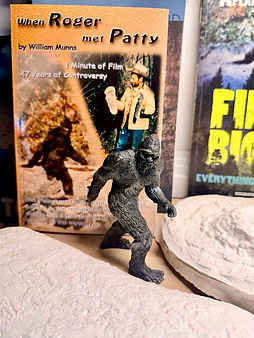
Bigfoot - our favourite mystery

1996 Dr Meldrum Sasquatch cast, USA

1967 Patterson - Gimlin Bigfoot cast, USA
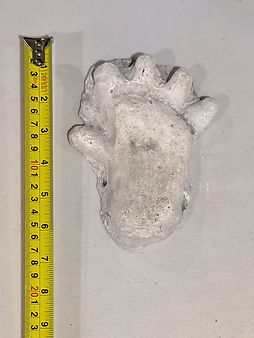
2013 Barackman and Sandradiputra Orang Pendek cast, Sumatra

1967 Bob Titmus Bigfoot cast, USA

1996 Dr Meldrum Sasquatch cast side profile displaying print depth and flexibility, USA

1967 Patterson - Gimlin Bigfoot cast, USA

1996 Dr Meldrum Sasquatch cast feat. mid-tarsal break and mid-foot flexibility, USA

1967 Bob Titmus Bigfoot cast displaying a prominent mid-tarsal break, USA

2013 Barackman and Sandradiputra Orang Pendek cast, Sumatra
The South Coast Mermaid

The Bloom-born Siren of the Southern Tides - Everything on display is real. The mermaid, however, remains a mystery...
"Discovered on the shores of Aldinga Beach during the great toxic algal bloom, this strange figure is said to have emerged from waters turned hostile to life.
Locals speak of a siren displaced by poisoned currents, a remnant of older oceans, when the sea still spoke of monsters.
Displayed here, not as proof... but as a question...
What else wakes when we wound the water?"
Collected and exhibited by South Coast Circus. Authenticity disputed... The warning remains...
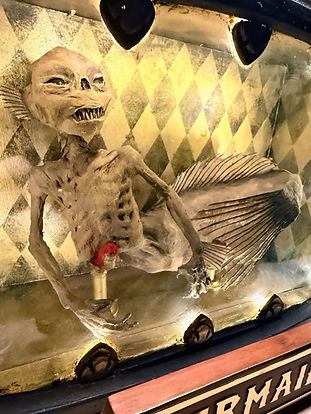
The South Coast Mermaid on display at South Coast Circus, Aldinga Beach
The Feejee Mermaid
Few curiosities are more closely tied to the golden age of the circus than the Feejee Mermaid.
Popularised in the 1840s by the legendary showman P. T. Barnum, the Feejee Mermaid blurred the line between fact and fiction, inviting audiences to wonder whether they were looking at a genuine creature from the depths or an elaborate illusion. It became one of the most famous exhibits in sideshow history and remains an enduring symbol of curiosity, mystery, and imagination.
More than a century later, that same sense of wonder found its way to South Coast Circus. In my early twenties, I encountered a Feejee Mermaid in a travelling sideshow. For a brief moment, it made me question everything I thought I knew before sending me down a rabbit hole of circus history, maritime folklore, and the strange world of curiosity cabinets.
That experience planted a seed. Years later, when creating the South Coast Cabinet of Curiosities, it felt only fitting that a Feejee Mermaid would become its centrepiece. Not because it answers any questions, but because it asks them. Like all great curiosities, it invites us to wonder, imagine, and explore the stories that live between myth and reality.

The original Feejee mermaid was believed to have been a taxidermied monkey sewn to a fish in Japan. It was likely lost in one of the infamous P.T. Barnum museum fires.
Curators Statement
This collection inhabits the space between extinction and endurance, myth and memory.
Fossils of deep time. Creatures once monstrous and real stand beside relics of animals declared lost yet still reported.
Modern marine life echos ancient oceans, while mythic forms and cultural carvings remind us that story is another way humanity records the unknown.
This cabinet makes the following observation:
That the unknown persists.
That extinction is sometimes complicated.
That imagination is often seeded in reality.
And that what we call myth may be memory refracted through time.
The world has been and remains more mysterious than certainty allows.
A world with no mystery is small and uninspiring. A world with unanswered questions is still alive!